
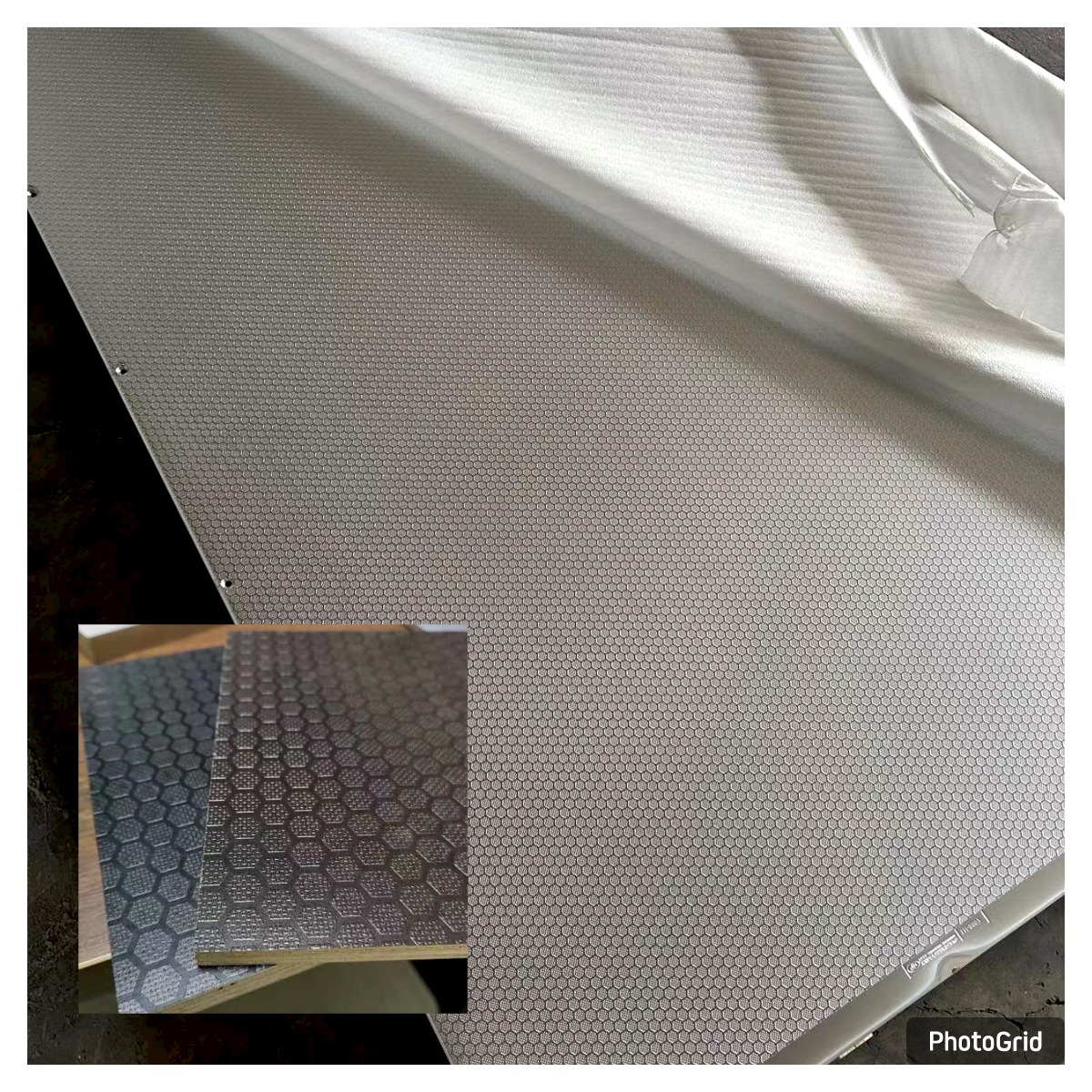
The primary distinction between Anti-slip Film Faced and formwork plywood lies in their surface texture. Anti-slip film faced Plywood, also known as Wiremesh Plywood, features at least one rough surface designed to reduce the risk of slipping for individuals working on the top of panel. This textured surface is achieved through two main factors:
1) The panel textures are created using various plates during the Film Face laminating hot press process, resulting in patterns such as hexagon, square, and rice patterns. In contrast, regular formwork plywood typically has a smooth surface to simplify maintenance after the concrete process.


2) Anti-slip Film Faced plywood utilizes a film face paper with a density of 220-240 grams, allowing for a clearly visible texture on the surface. On the other hand, formwork film face plywood commonly uses a thinner 120-gram film paper.
Moreover, Anti-slip film faced plywood stands out among formwork products due to its application in flooring for Vehicle’s flooring, performance stages, or industrial/commercial flooring purposes.
The other factors such as the paper soaking glue or the wood core materials are mostly depended on the specific quality requirements of the product and can be applied to both formwork plywood and Anti-slip Film Faced plywood.
Please contact us for Vietnam Anti-slip Film Faced plywood enquiries,
Loc Luong
Export Sales Department
Mail : locluong.kggroup@gmail.com
Whatsapp/Wechat No : 0902200987